Address
124 Tellico Port Rd, Vonore, TN 37885
Work Hours
- Monday – Friday: 8:00 AM – 5:00 PM
- Saturday: 9:00 AM – 3:00 PM
- (GMT-05:00) Eastern Standard Time
Address
124 Tellico Port Rd, Vonore, TN 37885
Work Hours
Address
124 Tellico Port Rd, Vonore, TN 37885
Work Hours
Address
124 Tellico Port Rd, Vonore, TN 37885
Work Hours
The morning drizzle has settled over the jobsite, and the daily distribution rush is starting. A crew lead steps up to an eight-foot-wide steel container, pulls the locking bars, and opens the standard cargo doors at the rear. Inside sits thirty feet of packed inventory: scaffolding components, bulk fittings, temporary generators, and boxed electrical spares. The problem is that the crew needs the spare valve pack loaded yesterday afternoon—the very first item packed into the container, now resting in the pitch-black shadows against the solid front wall. To get that single crate, two crew members must spend forty-five minutes hauling out half of the staging inventory onto wet gravel, exposing dry goods to the damp weather, only to reload it once the item is retrieved. By mid-morning, labor hours are burned, equipment is scuffed, and the staging yard is cluttered.
This daily operational bottleneck illustrates why evaluating shipping container door options is one of the most consequential decisions you make before securing an on-site storage unit. Buyers often focus primarily on general exterior footprint, yet door placement dictates how personnel move, how items are cataloged, and how rapidly goods can be retrieved. Choosing the wrong access layout can turn a simple storage asset into a chronic logistical hurdle. Conversely, matching door configurations to your daily loading rhythms turns static storage into an active, organized distribution hub.
Before reviewing specific configurations, it is critical to separate the container’s interior storage volume from its operational usability. A container with high cubic volume remains functionally restricted if your team cannot reach cargo without shifting intermediate inventory. When evaluating access layouts, examine three primary factors: handling frequency, stock rotation patterns, and external clearance geometry.
Static storage involves materials placed inside a container for weeks or months at a time without movement, such as seasonal equipment, archival records, or project overstock. In these scenarios, accessing items at the back is rare, making direct end-to-end access acceptable. Active retrieval, on the other hand, involves daily or hourly visits to retrieve tools, replenish consumables, or sort project inventory. Active retrieval requires either an aisle running down the center of the unit or multiple access points along the exterior envelope. If you use a single-door configuration for active storage without leaving a central walkway, personnel will constantly struggle with inaccessible cargo.
Warehouse managers and jobsite expeditors rely on specific inventory rotation principles:
Interior accessibility is only half the equation; external door swing dynamics dictate where a container can physically operate. Heavy steel cargo doors require an unobstructed arc to swing open. Before settling on an access style, inspect your yard’s physical perimeter:
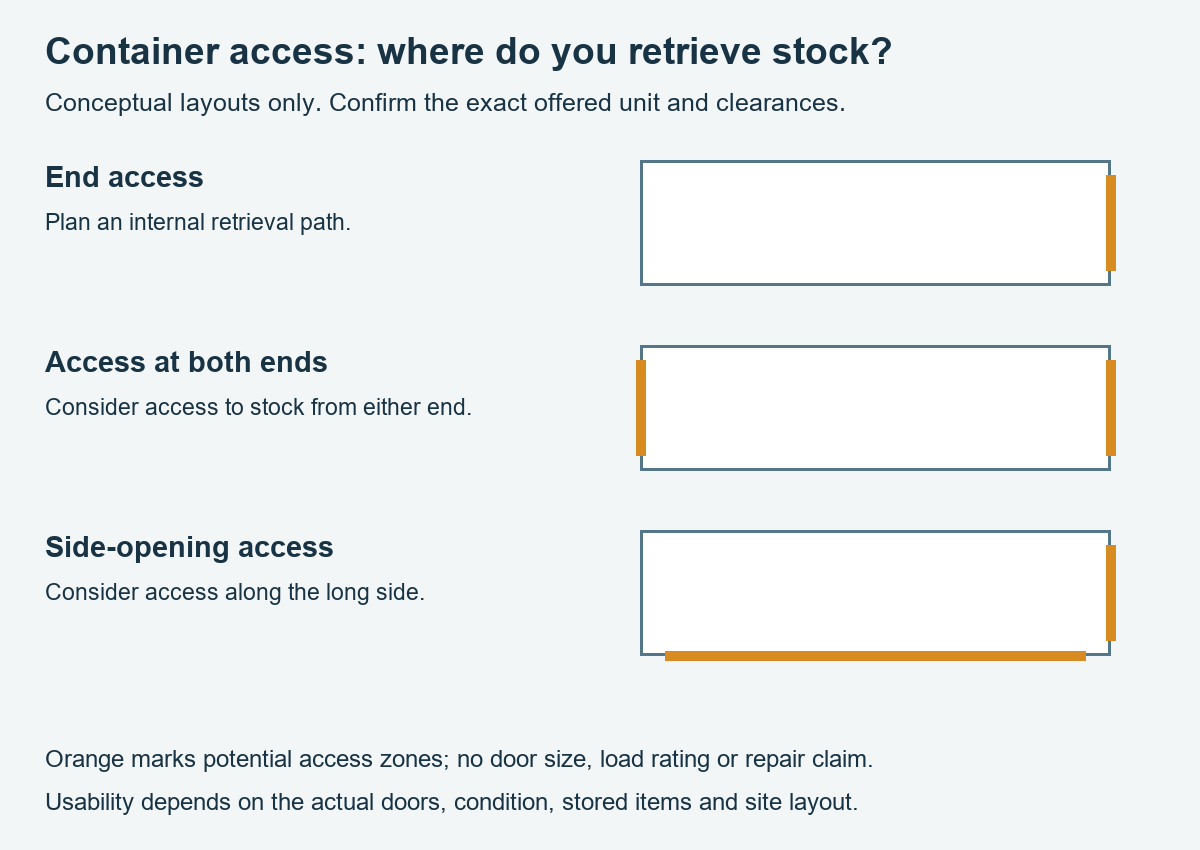
Standard end-door access features double doors mounted on one short end of the container, leaving the opposite end and both long sidewalls as continuous corrugated steel panels. This is the traditional access design found throughout industrial yards and private facilities.
The primary compromise of single-end access is internal floor space efficiency. If your inventory comprises diverse items requiring immediate access, you cannot pack the container edge-to-edge. Instead, you must sacrifice usable interior width to create a walking aisle down the center. This design turns a high-volume container into a narrower walk-in storage unit, reducing its effective bulk storage capacity. Furthermore, if long materials or large equipment pieces are loaded down the middle, they block access to anything stored along the rear or sidewalls.
Double-end containers, commonly called tunnel containers, have doors at both opposing short ends; confirm the actual doors operate properly. This configuration transforms the container from a closed chamber into an open-ended conduit.
Consider whether the following uses fit the exact unit and site:
Dual-door utility is not limited to long industrial containers; compact units also utilize this format to maximize tight yard footprints. For example, the 10ft Shipping Container with Double Doors features operational cargo doors at both ends. On restricted jobsites or urban yards where space is limited, having access from both ends allows you to position the container between work zones, providing dual access without requiring workers to walk around the exterior perimeter to retrieve supplies.
Deploying a tunnel unit requires deliberate site planning. You must maintain sufficient exterior clearance at both ends of the container. If a buyer places a double-door container with one end pushed flush against a property fence or building wall, the functional benefit of the second door assembly is completely lost. Ensure your site plan allows vehicle or personnel approaches at both ends.
Side-opening containers provide access along a long side; the opening extent and panel arrangement vary by design. Depending on the design, these units may feature bi-folding or multi-panel doors that open fully, leaving an expansive, unobstructed opening along the side profile, often while retaining standard cargo doors on the end.
Full side access completely reimagines how interior storage is organized. Instead of organizing items linearly from front to back, the container can be divided into distinct functional bays or inventory zones:
While side-opening access may help with selective retrieval, it requires substantial lateral clearance. The large folding or swing panels demand significant operating room alongside the unit. If your storage pad sits between two tight access roads or directly parallel to an active parking row, swinging open broadside door panels may block traffic. Before committing to a side-door configuration, consult baseline footprint planning resources like the 20ft shipping container dimensions guide to ensure your designated pad accommodates both the container footprint and the full outward swing radius of long side panels.
Because side-opening containers incorporate multiple moving panels, extensive perimeter seals, and complex latching gear, their physical condition requires close inspection—especially when evaluating secondary-market inventory. Buyers must distinguish between conceptual design benefits and the condition of a specific used unit.
Consider, for instance, inventory offered in “As-Is” condition, such as the 20ft High Cube Shipping Container with Full Side-Opening Doors – Used As-Is. When purchasing an as-is unit of this nature, you must account for specific disclosed limitations: this unit explicitly requires repairs to achieve wind and water tight integrity, the doors are hard to operate, and professional servicing is recommended.
A used as-is container with heavy, misaligned, or stiff side doors is not a turnkey storage solution for casual daily use. If side doors are hard to operate, crew members will struggle to open and close them repeatedly throughout the day without prior maintenance and servicing. Never assume a used unit operates with the smooth tolerance of newly manufactured equipment. Buyers considering used side-opening containers must assess whether their team has the time and resources to complete necessary servicing before putting the unit into active service.
To determine which door style matches your operational requirements, evaluate how your team will interact with the container on a typical day:
Container descriptions on paper do not always convey real-world operational condition. Door mechanisms rely on tight alignments, square frames, and intact gaskets. Before issuing a purchase order or scheduling delivery, review available inventory across the broader container catalog and present your seller with targeted questions:
To help your supplier match you with the correct door configuration, assemble your operational requirements before requesting a quote. Providing clear details upfront can help reduce avoidable re-handling or ending up with an incompatible unit:
By assessing how your personnel interact with stored inventory and verifying the actual operational condition of each unit, you can select the right container door configuration to support a smooth, efficient jobsite workflow.