Address
124 Tellico Port Rd, Vonore, TN 37885
Work Hours
- Monday – Friday: 8:00 AM – 5:00 PM
- Saturday: 9:00 AM – 3:00 PM
- (GMT-05:00) Eastern Standard Time
Address
124 Tellico Port Rd, Vonore, TN 37885
Work Hours
Address
124 Tellico Port Rd, Vonore, TN 37885
Work Hours
Address
124 Tellico Port Rd, Vonore, TN 37885
Work Hours
When deciding between a single axle vs tandem axle trailer, buyers often look at wheel counts or initial price tags instead of measuring their daily hauling demands. Picture an illustrative scenario: you are planning landscaping work, farm chores, or moving small machinery, standing in your driveway trying to determine whether a compact utility trailer fits your routine or whether your cargo demands two axles. Selecting the right utility trailer requires checking your actual cargo mass, verifying tow vehicle hitch ratings, measuring parking clearance, and planning for ongoing maintenance.
Quick Verdict: Shortlist exact utility trailer models that fit your cargo dimensions, documented cargo weight, and compatible vehicle towing ratings. A buyer may choose either axle configuration based on documented payload needs, bed size, or personal operating preferences, but extra axles alone are never proof of legal cargo capacity or structural stability.
The first step in evaluating a single axle vs tandem axle trailer is defining the exact items you plan to haul. Axle configuration alone is not a substitute for a verified payload rating. Every utility trailer operates within specific engineering limits established by its frame structure, suspension components, and individual tire load ratings.
List your intended cargo alongside necessary tie-downs, fuel cans, implements, and ramps. Bulky but lightweight items like garden debris or branch trimmings place very different demands on a utility trailer than dense materials like damp soil, crushed gravel, or compact machinery. Measure your cargo length, width, and center of mass, and compare your planned load layout and securement points with the exact manufacturer instructions. Taking actual measurements before you compare utility trailers prevents buying an undersized utility trailer bed or selecting unneeded capacity.
When weighing a single axle vs tandem axle trailer, compare the verified specifications of each candidate model against your storage site and operational budget across three core checks:
Comparing these documented figures lets you see whether the space requirements and routine maintenance schedule of a particular utility trailer align with your property and upkeep budget.
Understanding official certification terminology is critical before completing a purchase. As explained in the Big Tex owner manual, Gross Vehicle Weight Rating (GVWR) is the maximum permissible total weight of the trailer plus all cargo. You must never exceed the utility trailer gvwr, the Gross Axle Weight Rating (GAWR), or individual tire load ratings. Furthermore, the manufacturer manual notes that the tow vehicle and hitch must be appropriately rated for the trailer GVWR, and electric trailer brakes require an in-cab compatible brake controller.
Calculating your net utility trailer weight capacity begins with basic subtraction:
Available Payload Budget = GVWR − Trailer Empty Curb Weight
Consider an illustrative arithmetic example: suppose a tandem utility trailer lists an official GVWR of 6,000 lbs and an unladen empty curb weight of 1,800 lbs. Subtracting curb weight from the gross rating yields an initial cargo allowance of 4,200 lbs. However, this arithmetic is merely a weight-budget starting point; it is never permission to exceed individual axle ratings, tire capacities, tongue weight thresholds, or vehicle towing limits. Always check your vehicle owner manual to ensure your hitch receiver, ball mount, and towing ratings accommodate the utility trailer gross weight.
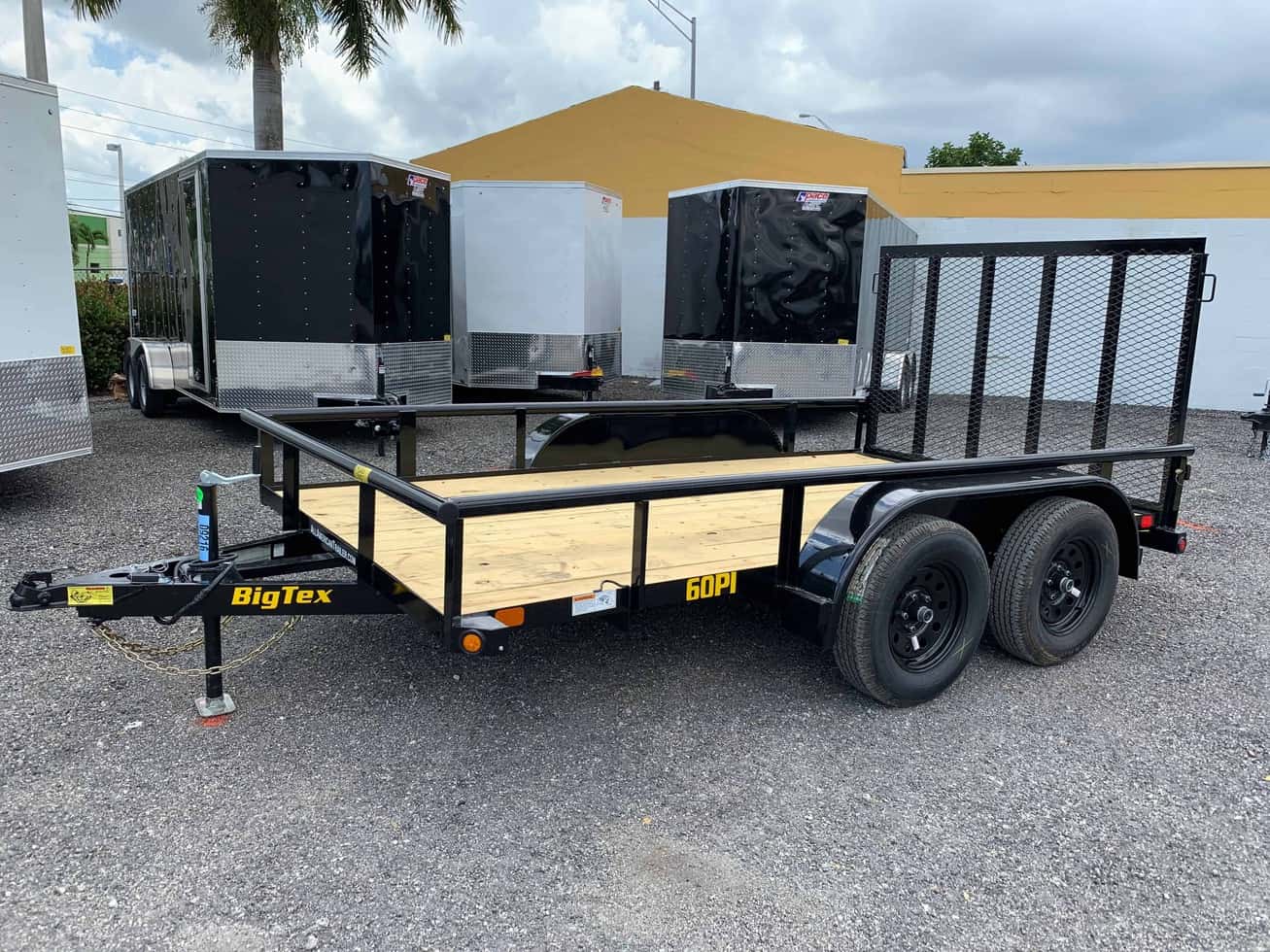
Reviewing published manufacturer documentation shows how axle layouts correlate with official engineering ratings across different model designs. For example, in the published Big Tex utility trailer range, a single-axle 30SA model lists a 2,995 lb GVWR, whereas a tandem-axle 60PI pipe model lists a 6,000 lb GVWR.
These figures represent published manufacturer family specifications rather than certification for every utility trailer build on the market. Always inspect the manufacturer certification label and VIN data plate attached to the frame of the specific utility trailer you are evaluating to confirm its exact GVWR, axle ratings, and tire specifications before making a commitment.
Use this evaluation matrix to log verified equipment data and eliminate incompatible utility trailers from your shortlist:
| Decision Factor | Information to Record | Single Axle Candidate | Tandem Axle Candidate | Eliminate Candidate If |
|---|---|---|---|---|
| Loaded Cargo Mass | Total weight of cargo, securement gear, and ramps | Compare against candidate net payload rating | Compare against candidate net payload rating | Loaded cargo mass exceeds utility trailer net payload rating |
| Cargo Dimensions & Layout | Length, width, and planned load position | Verify against deck size and loading instructions | Verify against deck size and loading instructions | Cargo layout violates manufacturer loading instructions |
| Towing Compatibility | Tow vehicle rating, hitch class, and brake controls | Check against candidate GVWR and brake setup | Check against candidate GVWR and brake setup | Utility trailer GVWR exceeds vehicle or hitch receiver ratings |
| Storage & Parking Access | Measured storage length, width, and approach access | Test measured access path against unit dimensions | Test measured access path against unit dimensions | Candidate dimensions exceed measured access or storage boundaries |
| Running Gear Upkeep | Component count and scheduled service items | Record tires, hubs, and service intervals | Record tires, hubs, and service intervals | Scheduled upkeep requirements exceed planned maintenance budget |
A single axle trailer can haul 2,000 lbs of cargo only if that specific utility trailer has an official available payload rating that accommodates the load. The utility trailer GVWR minus its empty curb weight must leave at least 2,000 lbs of margin without exceeding GAWR, tire load ratings, or tow vehicle hitch limits. Verify the VIN certification plate on the utility trailer frame before loading.
Potential disadvantages of a tandem axle utility trailer depend entirely on comparing candidate records against a single axle candidate. If the specific tandem model lists additional running gear components, a higher unladen curb weight, or larger external dimensions, those factors represent disadvantages only if they demand more maintenance, consume tow vehicle capacity, or exceed storage space beyond what your hauling needs justify.
Choosing between a single axle vs tandem axle trailer comes down to matching verified cargo dimensions and weights against documented equipment limits. Take time to compare available options across open utility trailers, evaluate bed dimensions against your equipment, and ask about the offered trailer specifications to verify individual VIN data plates, hitch compatibility, and current fulfillment policies before completing your order.