Dump Trailer Maintenance: Practical Inspection and Service Planning Guide

Plan routine dump trailer maintenance safely. Learn visual pre-trip checks, critical safety boundaries, and when to call qualified service technicians.
Quick Verdict: Effective dump trailer maintenance starts with disciplined visual inspection before and after every haul, paired with strict safety boundaries. Never position yourself beneath a raised dump bed, leave hydraulic repairs to qualified technicians, and always consult your specific manufacturer manual for exact component specifications and service schedules.

Picture a busy job site at sunrise: the tow rig is running, a heavy load of gravel is waiting, and the hydraulic hoist is ready for the day’s first cycle. Proactive dump trailer maintenance is what separates an efficient workday from an expensive roadside breakdown or a catastrophic worksite hazard. Because dump trailers combine structural chassis stress, heavy payload dynamics, and high-pressure hydraulic lifting systems, routine planning requires an organized approach to inspection, cleanliness, and professional service support.

Dump Trailer Maintenance: Pre-Trip and Post-Haul Checks

A systematic routine is the cornerstone of responsible dump trailer maintenance. Rather than guessing when components need attention, establish a consistent walk-around routine every time you hitch up and after you unload.

  • Coupler and Safety Chains: Inspect the hitch coupler mechanism for latch engagement, cracks, and physical distortion. Confirm safety chains and breakaway cables are intact and correctly rated for your gross vehicle weight.
  • Tire Integrity and Lug Nuts: Check tire treads for uneven wear patterns, sidewall cracking, embedded debris, and proper inflation matching manufacturer cold-pressure ratings. Visually verify lug nut seating.
  • Lighting and Electrical Connections: Test brake lights, turn signals, clearance markers, and the primary harness plug to verify clean pin connections and reliable grounding.
  • Structural Welds and Fasteners: Examine the tongue, chassis crossmembers, gate latches, and dump bed hinges for signs of metal fatigue, stress fractures, or loose mounting hardware.
  • Battery Charge Level: Check that the onboard battery, if fitted, powering your hydraulic pump holds adequate charge to complete multiple lift cycles without strain.

Running Gear, Couplers, and Visible Wear Points

The running gear on a dump trailer endures severe twisting forces, dynamic payload shifts, and abrasive job-site debris. Incorporating structural wear points into your regular dump trailer maintenance helps you identify developing mechanical issues before they compromise road safety.

Pay close attention to suspension components, including leaf springs, equalizers, and axle hangers. Any misalignment, missing bushings, or sagging springs indicates that the trailer requires qualified workshop evaluation. For wheel bearing lubrication, brake adjustment, and torque specifications, always reference your unit-specific owner’s manual. Operating conditions vary dramatically between highway hauling and muddy excavation sites, making model-specific guidance essential for dependable dump trailer maintenance.

Hydraulic Safety Boundaries: Leave Internal Service to Qualified Technicians

The hydraulic system is the operational heart of any dump trailer, yet it presents the most serious safety hazards. Strict safety protocols must govern this aspect of dump trailer maintenance.

Never position yourself beneath a raised dump bed. Stop using the trailer if you suspect a fault and have a qualified service professional assess it using the manufacturer’s instructions.

Routine owner maintenance for hydraulics should remain strictly observational:

  • Monitor fluid levels in the reservoir using only the fluid grade designated in your manufacturer documentation.
  • Visually scan exposed hydraulic hoses, fittings, and cylinders for weepage, blistering, or chafing.
  • Keep electrical terminals on the hydraulic pump and solenoid clean, tight, and free of corrosion.

If you observe leaking seals, spongy hoist performance, or erratic lowering behavior, assign the repair to a qualified hydraulic technician. High-pressure hydraulic fluid injection and accidental bed collapse pose severe crushing risks that require professional tools and qualified service personnel.

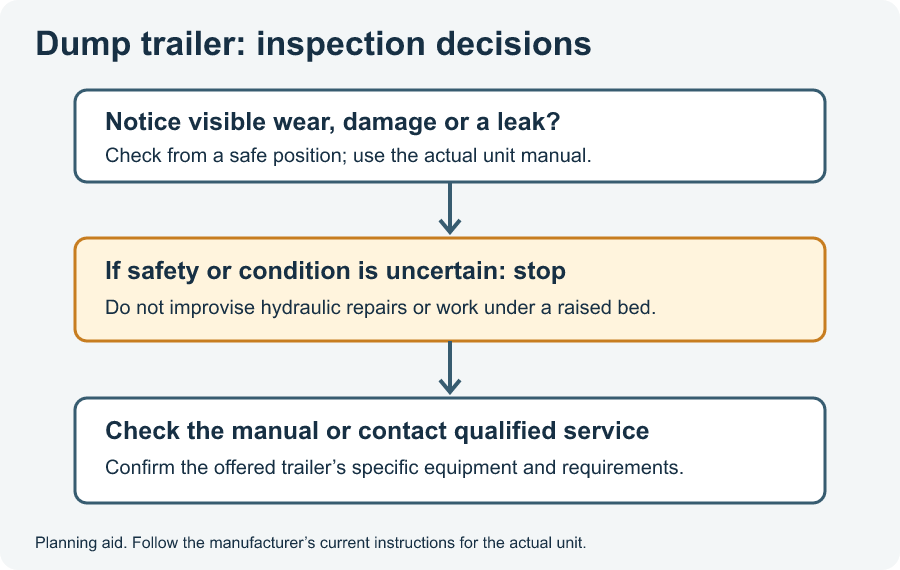
Dump trailer inspection decision flow: stop when uncertain and consult the manual or qualified service.
Use this decision flow to plan inspection and qualified service. Follow the manual for your specific trailer.

Washing, Storage, and Service Recordkeeping

Environmental exposure accelerates steel corrosion and electrical degradation. Post-use care is an essential yet frequently overlooked phase of ongoing dump trailer maintenance.

After hauling corrosive materials such as road salt, wet mulch, green waste, or fertilizer, thoroughly wash the dump bed, undercarriage, and hinge pivots with clean water. Ensure all bed drainage holes remain clear so standing water does not pool inside the box. Store the trailer on level, well-drained ground, and follow the battery and trailer manufacturers’ instructions for charging and extended storage.

Maintaining a dedicated physical or digital service logbook completes your dump trailer maintenance plan. Document every visual check, professional repair, component replacement, and dealer inspection. A documented maintenance history helps you track recurring problems, plan service and provide useful information when trading or selling equipment.

Aligning Inspection Routines with Real-World Duty Cycles and Environments

Standard service schedules printed in an equipment manual establish a baseline, but rarely do two haulers subject their trailers to the same mechanical stresses. A unit dedicated to transporting landscape mulch once a week experiences entirely different degradation patterns than one hauling crushed concrete or wet topsoil daily across uneven excavation sites. To keep your equipment safe and functional without unnecessary downtime, your maintenance planning must account for both payload characteristics and environmental exposure.

Operating environments further amplify these stressors:

  • Corrosive Conditions: Operating in coastal environments or on winter roads treated with liquid deicers (magnesium or calcium chloride) calls for cleaning and inspection planning in accordance with the relevant manufacturer instructions for structural steel seams, brake assemblies, and electrical grounding terminals.
  • Unpaved and Rough Haul Routes: Continuous travel over washboard gravel, rutted access roads, or construction staging grounds subjects the entire suspension, axle mounts, and fastener assemblies to severe high-frequency vibration. Under these conditions, torque checks and bushing wear checks should occur as recommended by the manufacturer and service professional.

The Practical Stop-Use Protocol: When to Red-Tag a Trailer

In fast-paced hauling environments, operators often face pressure to finish a run despite noticing an emerging mechanical anomaly. However, continuing to operate a compromised dump trailer introduces extreme safety hazards, risks catastrophic roadside failure, and drastically increases eventual repair costs. Implementing a strict “stop-use” protocol establishes clear, objective boundaries for when a trailer must be parked and red-tagged immediately.

A trailer should be taken out of service for professional assessment when you observe any of the following conditions:

  • Frame or Structural Anomalies: Any visible crack in a structural weld, particularly along the main I-beam or tube chassis, crossmember intersections, coupler connection points, or the scissor/hoist mounting subframe. Visible deflection, twisting, or sagging along the length of the frame rails is an immediate red flag.
  • Suspension and Axle Shifts: Loose, broken, or missing U-bolts; shifted axle alignments; cracked leaf spring leaves; or wallowed-out spring hanger holes. Any movement in these areas compromises highway tracking and can lead to axle detachment under load.
  • Hydraulic Fluid Leaks or Hoist Instability: Any active dripping, weeping around hose crimps, or visible cylinder fluid release requires immediate cessation of use. Operating with compromised hydraulics risks sudden mechanical collapse. Safety Mandate: Hydraulic circuits operate under extreme hydraulic pressure that can penetrate human tissue. Never attempt to tighten fittings while pressurized, never inspect for leaks using your hands, and never attempt DIY hydraulic repairs. All hydraulic troubleshooting must be directed to a qualified fluid-power professional.
  • Improper Bed Seating: If the dump body does not rest fully and evenly on the lower frame stops when fully lowered, the trailer must not be loaded. Uneven load distribution can bend the hoist assembly or twist the main rails during transport.

Maximizing Shop Visits: How to Prepare for Professional Service

Follow these steps to prepare your trailer before dropping it off at the repair facility:

  • Thoroughly Clean the Undercarriage and Running Gear: Technicians cannot adequately inspect structural welds, crossmembers, brake linkages, or axle mounts if they are caked in dried mud, asphalt residue, or hardened gravel dust. Wash the chassis thoroughly prior to drop-off, avoiding direct high-pressure spray on sealed wheel hubs and electrical control modules.
  • Compile an Objective Symptom Log: Rather than stating that the trailer “bounces oddly” or “dumps slowly,” provide specific, reproducible observations. Note whether a squeak occurs empty or loaded, if the electric brakes pull toward one side under heavy braking, or if hoist hesitation happens exclusively on the first run of the morning. Include details on average payload weights and typical route conditions.
  • Bring Service Records and Manuals: Provide your log of previous grease intervals, bearing repacks, and component replacements, alongside the manufacturer’s documentation. This can help technicians understand previous work and investigate recurring issues.
  • Consolidate Preventative Maintenance Tasks: Take advantage of shop downtime. If the trailer is already in the bay for brake shoe replacement, ask which additional checks are appropriate for your trailer, its condition and the manufacturer’s service schedule.

Choosing a Trailer with Maintainability in Mind

Long-term maintenance costs and downtime are often dictated on the day you purchase your equipment. When exploring commercial dump trailers, looking beyond gross capacity and dimensional volume toward specific structural, electrical, and mechanical design details will directly impact how easily the trailer can be maintained over its working lifespan.

Key design attributes that facilitate practical maintenance include:

  • Protected Electrical Architecture: Look for wiring harnesses that are completely enclosed within protective conduit or routed through frame channels with rubber grommets. Exposed wiring zip-tied along the exterior of frame rails is easily damaged by flying stone debris and brush, leading to intermittent ground faults. Modular, sealed plug-and-play wiring connectors are vastly easier to service than spliced-and-taped systems.
  • Modular, Bolt-On Components: Components subject to road collisions or severe wear—such as front jacks, couplers, fenders, and rear light housings—should ideally be bolt-on assemblies rather than fully welded to the primary frame. Ask the dealer how replacement components are serviced and which tasks require a qualified workshop.
  • Enclosed and Weatherproof Hydraulic Stations: Ask how the pump, reservoir and battery are protected from weather and how their enclosure meets the manufacturer’s access and ventilation requirements. Ensure the box allows sufficient space for easy top-off access, battery terminal cleaning, and clean visual fluid level checks without needing to remove auxiliary equipment.

Equip Your Business with the Right Dump Trailer

Consistent dump trailer maintenance keeps your equipment working efficiently season after season. If you are planning an equipment addition or need to match your payload demands with the right trailer capacity, explore our equipment resources. You can browse dump trailers in our inventory or consult our detailed dump trailer size guide to select the ideal specifications for your hauling operations.

Newsletter Updates

Enter your email address below and subscribe to our newsletter

Welcome to Container Supcon

Your first order.
10% less.

Save on every product in your first order. Enter this code at checkout.

WELCOME10

First-time buyers only. All products, including sale items. One use per customer. Applies to products before tax and shipping. Cannot be combined with another coupon.