Address
124 Tellico Port Rd, Vonore, TN 37885
Work Hours
- Monday – Friday: 8:00 AM – 5:00 PM
- Saturday: 9:00 AM – 3:00 PM
- (GMT-05:00) Eastern Standard Time
Address
124 Tellico Port Rd, Vonore, TN 37885
Work Hours
Address
124 Tellico Port Rd, Vonore, TN 37885
Work Hours
Address
124 Tellico Port Rd, Vonore, TN 37885
Work Hours
Compare typical 20ft, 40ft and high-cube shipping container dimensions, door openings and usable interior space before choosing a unit.
Shipping container dimensions are usually described by nominal length: 20 feet or 40 feet. Most standard dry containers are about 8 feet wide and 8 feet 6 inches high outside; a high-cube container is typically one foot taller. Usable interior and door-opening measurements are smaller, and exact measurements vary by manufacturer, model, age and configuration. Confirm the specific unit before planning a tight fit.
| Type | Typical exterior | Representative interior | Representative door opening |
|---|---|---|---|
| 20ft standard dry | 20ft × 8ft × 8ft 6in | 5.90 × 2.35 × 2.39m | 2.34 × 2.28m |
| 40ft standard dry | 40ft × 8ft × 8ft 6in | 12.03 × 2.35 × 2.39m | 2.34 × 2.28m |
| 40ft high cube | 40ft × 8ft × 9ft 6in | Varies by equipment; typically about 1ft taller than standard | Confirm on the selected unit |
These are planning references for common dry equipment, not a promise about an individual container. Blue Water Shipping publishes representative 20ft and 40ft dry-container specifications and warns that equipment can vary. Hapag-Lloyd makes the same manufacturer-variation point for its 40ft equipment. Always use the listing and unit documents for a purchase decision.
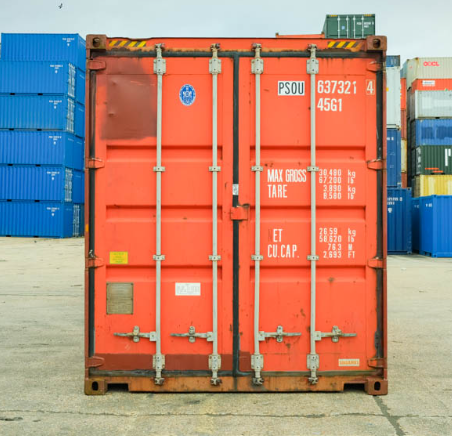
Exterior length, width and height determine the site footprint, overhead clearance and transport planning. The nominal label is rounded: a “20ft” or “40ft” name does not replace an exact measurement.
Interior measurements describe usable space. Steel framing, corrugated walls, flooring and the roof reduce the inside length, width and height compared with the exterior. Liners, refrigeration equipment, insulation or modifications can reduce it further.
The door aperture is narrower and lower than the interior. Measure the widest and tallest item, including packaging, pallets and handling clearance. A load that fits inside may still fail to pass through the doors.
Cubic capacity estimates volume. Tare is the empty container weight. Payload is the cargo allowance for a particular unit and rating. These values are useful for planning, but they are not interchangeable and should be confirmed from the exact container plate or documentation.
A common 20ft dry reference lists about 5.90m internal length, 2.35m internal width, 2.39m internal height and a 2.34 × 2.28m door opening. See the detailed 20ft shipping container dimensions guide for imperial conversions, loading checks and configuration differences.
For current inventory, compare 20 foot containers, including the 20ft GP repainted standard and 20ft dry van new container.
A representative 40ft standard dry unit has about 12.03m internal length, 2.35m internal width and 2.39m internal height. High-cube models add roughly one foot of exterior height, which can help with bulky goods and overhead working room. Read the full 40ft container dimensions guide, then compare 40 foot containers and high-cube containers.
Reefers use interior machinery and insulated panels, so their usable space differs from a dry van. Open-top units change overhead-loading access. Flat racks may not have conventional walls or a roof. Side-opening containers add access points and door hardware. Treat the type name as a starting point and verify the drawing or dimensions of the exact configuration.
Start with the items, equipment or workflow, then choose the container. A 20ft unit can suit compact sites, dense loads and smaller storage plans. A 40ft unit offers more floor length for bulky inventory or separated zones, while a high cube adds vertical room. Also compare condition: the new versus used shipping container guide explains one-trip, cargo-worthy, wind-and-watertight and as-is grades.
After completing your checklist for measuring equipment, aisles, and doors, review vehicle width, door swing, and driver exit needs in the guide to checking car fit before using a shipping container as a garage.
Container dimensions are only one part of the footprint. The current Delivery Guide recommends planning for a clear, stable, reasonably level area and truck access. Its planning minimums are 60 feet of straight-line space for a 20ft unit or 110 feet for a 40ft unit, plus 12 feet of width and 14 feet of vertical clearance. Actual needs depend on the carrier, truck, terrain and placement.
Check overhead wires, trees, gates, turns and ground conditions. Decide door orientation and mark the placement location before dispatch. For grades and condition terminology, use the Container Grades guide.
Many standard ISO dry containers are nominally 8 feet wide outside, but specialty equipment can differ. Confirm the exact unit.
A common high-cube unit is about one foot taller outside than a standard container. Interior and door dimensions still vary.
Manufacturers, equipment series, flooring, doors, insulation and modifications can change usable dimensions. Reference tables should be treated as typical.
Use exterior dimensions for the site and delivery plan, interior dimensions for usable space, and door-opening dimensions for loading.
Ask Container Supcon to confirm the selected unit’s measurements and configuration before ordering or building around it.
Use this shipping container dimensions guide to narrow the size, then compare current container inventory. Contact Container Supcon to confirm the exact unit’s dimensions, condition, configuration and delivery fit before you order.
Once you know the space you need, compare high cube versus standard containers and use the container cost checklist to compare suitable listings on the same basis.