Address
124 Tellico Port Rd, Vonore, TN 37885
Work Hours
- Monday – Friday: 8:00 AM – 5:00 PM
- Saturday: 9:00 AM – 3:00 PM
- (GMT-05:00) Eastern Standard Time
Address
124 Tellico Port Rd, Vonore, TN 37885
Work Hours
Address
124 Tellico Port Rd, Vonore, TN 37885
Work Hours
Address
124 Tellico Port Rd, Vonore, TN 37885
Work Hours
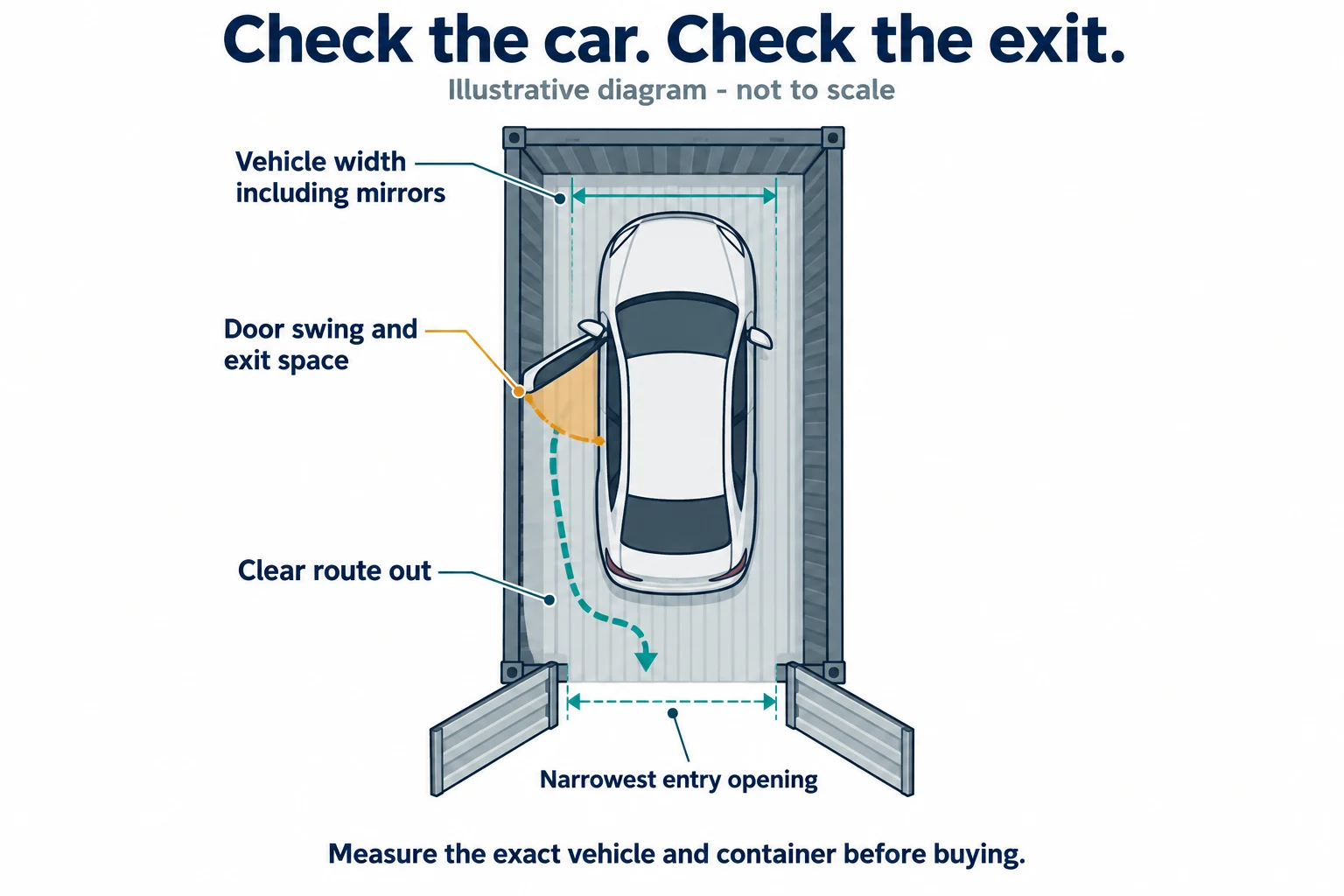
Using a standard shipping container as a garage works only when the physical numbers line up for your specific vehicle and your site. Before you buy any container, you need to answer one decisive question: once the car is inside, can you get out of it safely? Picture this illustrative scene: you pull your car smoothly through the cargo doors, shut off the ignition, and push open the driver door. It immediately bangs against the corrugated steel wall, opening barely six inches. Squeezing through an open window or climbing over the console is frustrating and unsafe. If you cannot open the door enough to step out comfortably, an unmodified container will not work as your garage.
Whether you plan to park a vehicle every day or store it between seasons, you must be able to exit and retrieve the car reliably every single time. Check the condition of the exact container as well as the space available. Start with the measurements before committing to a purchase.
When planning a shipping container garage, do not compare only bumper-to-bumper vehicle length with nominal container length. In practice, interior width, door opening width, and driver exit clearance determine whether parking is practical. Total vehicle length alone is never enough to evaluate fit.
To see real-world boundaries, examine published ocean carrier fleet specifications. For example, published fleet data from Hapag-Lloyd for standard 20ft containers lists typical interior dimensions of roughly 5,900 mm long, 2,352 mm wide, and 2,395 mm high (about 19 feet 4 inches by 7 feet 8.5 inches wide by 7 feet 10 inches tall), with a rear door opening of roughly 2,340 mm wide by 2,292 mm high (about 7 feet 8 inches wide by 7 feet 6 inches high). Similarly, fleet data from Hapag-Lloyd for standard 40ft containers lists an interior length of approximately 12,032 mm (about 39 feet 5 inches), but keeps the exact same interior width of 2,352 mm and door width of 2,340 mm. These carrier figures are fleet reference examples only, not inventory guarantees for specific units. Verify the exact candidate unit; the carrier notes manufacturer variation.
Review common industry sizes on our shipping container dimensions guide. Before browsing candidate 20 foot containers or longer 40 foot containers, work through this practical measurement checklist:
How you plan to use the space determines whether an unmodified container fits your goals:
Buyers planning a project frequently ask: How much would a shipping container garage cost? Rather than relying on guesswork, estimate your budget across these practical expense categories:
Before purchasing, confirm these critical site and safety factors:
Delivery Access: Delivery trucks carrying 20ft or 40ft containers require ample straight-line space, overhead clearance free of low branches and power lines, and firm ground. Check our delivery guide to review site access requirements before scheduling a delivery truck.
Moisture Planning: Steel containers react to outdoor temperature shifts. When you pull a wet or warm vehicle inside an enclosed steel box, condensation can form on the walls and ceiling. Plan appropriate moisture management and airflow for your site, unit, and storage plan. Learn more about airflow options in our guide to shipping container ventilation.
Engine Emissions Safety: According to the Centers for Disease Control and Prevention (CDC), fuel-burning engines produce carbon monoxide, a dangerous gas that can build up indoors, and generators must never be used inside garages or enclosed spaces. Never idle a vehicle or run an engine inside a container for testing or warming up.
Permits and Rules: Check with your local municipal building or zoning office about intended vehicle parking and container placement on your property before placing an order.
When weighing your alternatives, you may ask: Are shipping container garages worth it? A shipping container garage is worth it if your vehicle measurements confirm comfortable door opening and driver exit, your site has straight truck and vehicle access, and you want durable steel shelter without building a stick-frame structure. It is not worth it if your vehicle is too wide to exit easily or if you need an expansive garage with workshop aisles.
Many property owners also ask: Is it cheaper to buy a shipping container or build a shed? The answer depends on comparing complete, equivalent quotes that factor in the structure, delivery, foundation work, and assembly. To evaluate traditional storage alternatives beside container structures, see our comparison on a shipping container shed.
If you have measured your vehicle and want to confirm available container options, reach out through our contact page. Share your vehicle dimensions, delivery ZIP code, and preferred container size. Ask about candidate-unit dimensions, condition and delivery requirements before you order.