Address
124 Tellico Port Rd, Vonore, TN 37885
Work Hours
- Monday – Friday: 8:00 AM – 5:00 PM
- Saturday: 9:00 AM – 3:00 PM
- (GMT-05:00) Eastern Standard Time
Address
124 Tellico Port Rd, Vonore, TN 37885
Work Hours
Address
124 Tellico Port Rd, Vonore, TN 37885
Work Hours
Address
124 Tellico Port Rd, Vonore, TN 37885
Work Hours
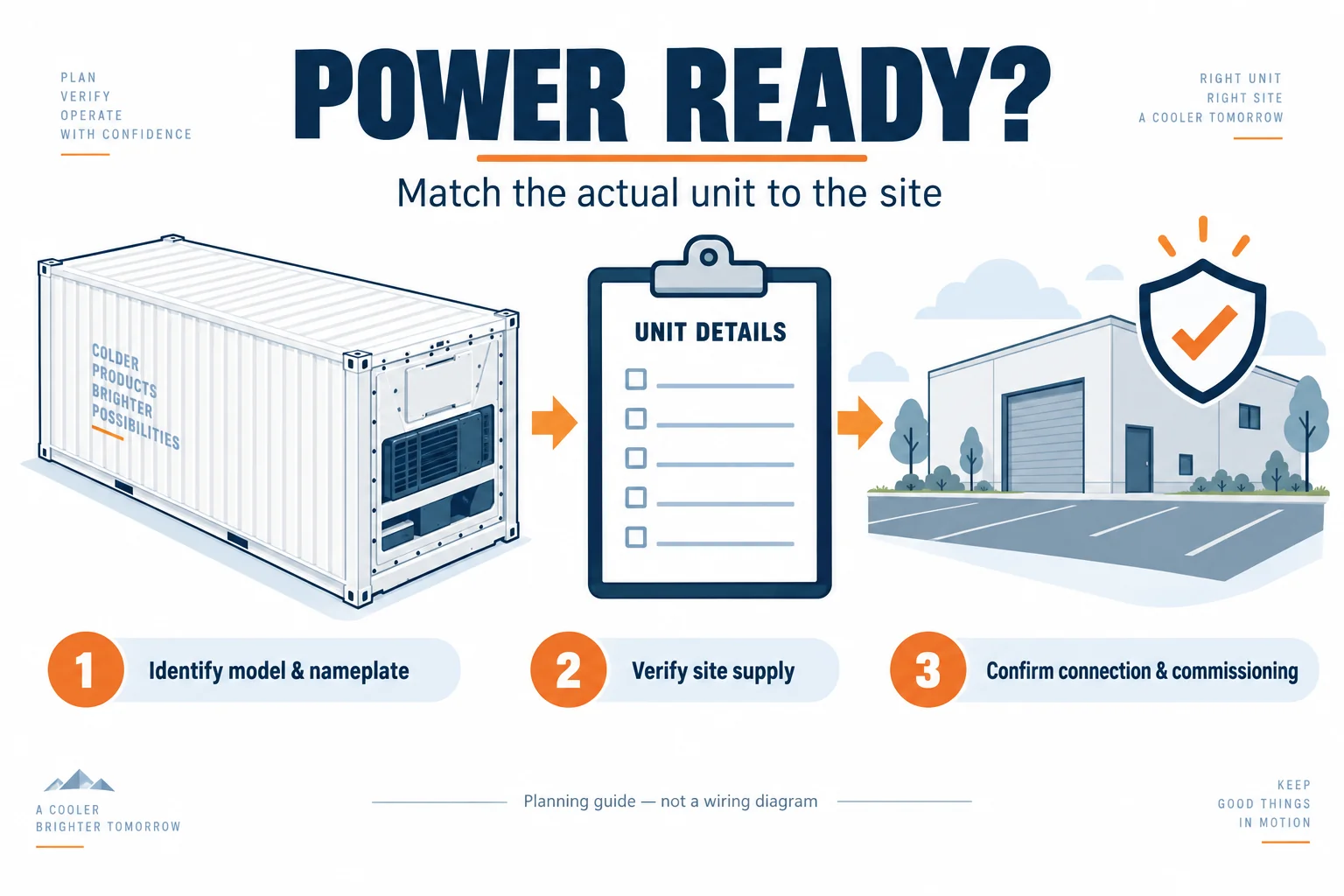
Planning Snapshot: Many container reefer systems use nominal supplies around 380–460 V AC, three-phase, at 50 or 60 Hz. That planning expectation is supported by the Carrier PrimeLINE T-372 manual and Thermo King MAGNUM+ operator manual, not a specification for ContainerSupCon’s particular unit. Refrigerated container power requirements also include current, connection and operating-cost questions. Here are five checks to turn those numbers into a practical purchase plan.
Imagine delivery booked before anyone has matched the cooling unit to your site’s electrical supply. The truck is on its way; the power question is still unanswered. Before buying a refrigerated container, put the machine details and the site details on the same page. That is a better starting point than discovering the mismatch beside the delivery truck.
What are the electrical requirements for a 40-foot refrigerated container? Start with the supply examples below, then identify the refrigeration machinery actually fitted to the reefer. Box length alone is not enough information to select an electrical connection.
Keep a photo of the refrigerated container’s identification plate, the model and serial number, and its matching manual together. Ask for any missing electrical documentation. This gives your supplier and installer a specific unit to assess, rather than an anonymous “40-footer.”
Still choosing between powered cooling and passive storage? Read our refrigerated versus insulated container comparison. For a second-hand reefer, use the used refrigerated container checklist to organize condition and operating records.
What powers a refrigerated shipping container? The all-electric systems in these manuals use an external electrical supply. How do refrigerated shipping containers get power? Their power cable connects to a compatible supply; connection suitability must be assessed for the actual reefer and site.
| Characteristic | Documented examples | Meaning for the buyer |
|---|---|---|
| Voltage, phase and frequency | Carrier PrimeLINE: nominal 380/460 V, three-phase, 50/60 Hz. Thermo King MAGNUM+: 380 V/50 Hz or 460 V/60 Hz, three-phase. | These examples span roughly 380–460 V. This is a span of nominal supply examples, not permission to connect any unit at every voltage in between. |
| Current | Carrier ThinLINE 69NT40-541-500 to 599: compressor full-load current 17.6 A at 460 VAC, with current limiting set at 21 A; CB-1 trip value 29 A. | Compressor current and a breaker trip threshold are different quantities. Neither is a universal whole-reefer operating current or a site breaker recommendation. |
| Electrical power | Daikin Zestia: maximum power consumption 13.5 kW. | A maximum rating is not measured average consumption. Do not multiply it into a guaranteed monthly bill. |
Sources: Carrier ThinLINE electrical data (Table 3–2) and Daikin Zestia specifications; the supply examples come from the linked Carrier and Thermo King manuals above. These are real equipment examples, not the electrical specifications of ContainerSupCon’s 10ft unit.
For your refrigerated container, confirm the required voltage, phase, frequency, whole-unit load and fitted options together. If the site information says only “230 V,” that leaves important questions unanswered: phase, equipment configuration and compatibility still matter.

Refrigerated container electrical requirements extend beyond a voltage number. Carrier documents different power cable and plug options, plus an optional autotransformer for nominal 190/230 V three-phase operation in its ThinLINE configuration and cable options. That is a manufacturer configuration example, not a promise that a reefer works from a household socket or a simple adapter.
Give a qualified electrical professional the actual reefer manual and your site information before agreeing installation work. Do not choose a cable, connector or generator from this article. The following reusable worksheet helps you obtain a specific assessment and an itemized quote.
| Collect | Record or request | Buyer decision |
|---|---|---|
| Refrigerated container identity | Model, serial number, plate photos, manual and missing records. | Are the quoted specifications for the actual unit? |
| Site supply and placement | Documented site supply, proposed location and photographs. | Can the proposed reefer and site be matched? |
| Cable and connection | Existing cable/connector photos and measured route to the planned reefer position. | What connection work should the qualified installer quote? |
| Generator, if planned | Exact refrigeration unit and proposed generator documentation. | Has compatibility been assessed, rather than guessed from one kW number? |
| Operating schedule | Hours, intended contents, loading pattern and required storage conditions. | What operating demonstration and monitoring are appropriate? |
| Quote and commissioning | Equipment, electrical work, delivery and startup responsibilities listed separately. | Who supplies each item, and when is the site ready? |
Check vehicle access separately using our delivery guide. A suitable power location and a suitable unloading location are two planning questions; draw both on the same site sketch.
Turn “the reefer runs” into a useful handover record: identify the refrigerated container tested, the test date, conditions, duration, readings and any faults reported. Ask for available pre-trip or operating reports and the agreed startup scope. A short demonstration is not evidence of every future operating condition.
For monitoring, separate a display someone checks on-site from an alert someone receives when away. Record what the actual reefer offers, who will check it, and who responds if power is lost. If backup generation is planned, include its compatibility assessment in the worksheet rather than assuming it is covered by the equipment purchase.
A refrigerated container’s power rating and its electricity bill answer different questions. kW describes electrical power; kWh describes energy over time. For a useful operating example, the Thermo King manual’s full-cool table lists 11.03 kW at 1.7°C return air and 7.57 kW at −17.8°C, under its stated 38°C ambient/R-404A conditions. Those are specific MAGNUM+ test points, not average consumption estimates for every reefer.
Illustrative cost calculation: suppose a refrigerated container averaged an assumed 5 kW for 10 hours, at an assumed $0.15/kWh energy rate. That is 5 × 10 = 50 kWh, and 50 × $0.15 = $7.50 for the energy component. Both the average load and tariff are hypothetical—not measured SKU consumption, a customer bill or a claim of constant draw.
For your reefer budget, replace those assumptions with measured consumption over a relevant operating period and your applicable tariff, including any other charges. Request the test conditions alongside the readings. Keep the purchase, electrical preparation, freight and maintenance quote lines separate from the energy estimate.
You now have realistic supply examples and a worksheet for resolving reefer power requirements. For the exact 10 foot reefer container being offered, confirm its data plate and documentation before ordering. The manufacturer examples above do not establish this refrigerated container’s voltage, amperage, phase, plug, power consumption or generator needs.
Send your delivery address, site photographs, intended use and refrigerated container questions when requesting a quote. Confirm address eligibility, availability and delivery arrangements; review our shipping policy. Contact ContainerSupCon at +1(865)336-0062 (Monday–Friday 08:00–17:00, Saturday 09:00–15:00 Eastern).