Address
124 Tellico Port Rd, Vonore, TN 37885
Work Hours
- Monday – Friday: 8:00 AM – 5:00 PM
- Saturday: 9:00 AM – 3:00 PM
- (GMT-05:00) Eastern Standard Time
Address
124 Tellico Port Rd, Vonore, TN 37885
Work Hours
Address
124 Tellico Port Rd, Vonore, TN 37885
Work Hours
Address
124 Tellico Port Rd, Vonore, TN 37885
Work Hours
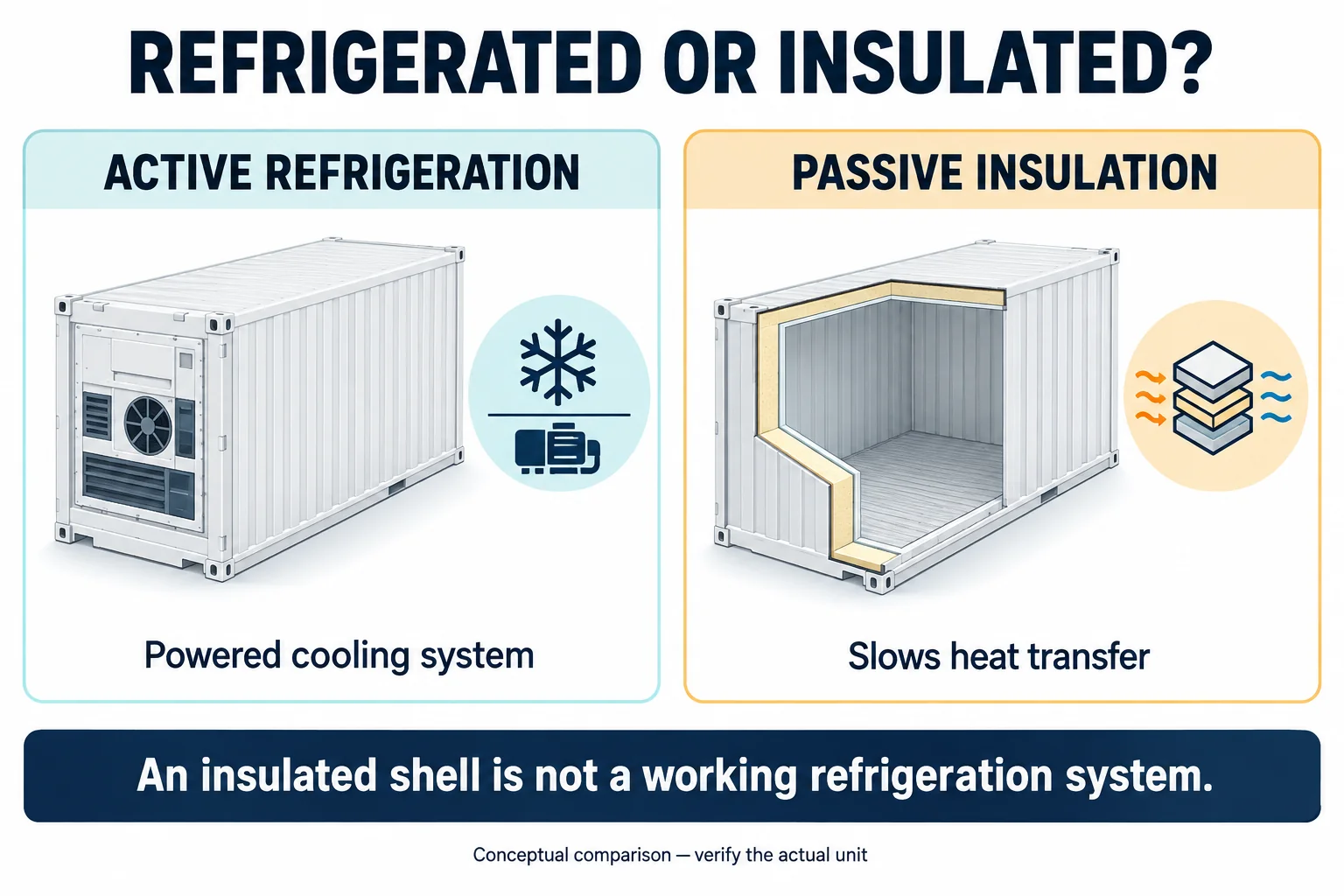
Quick Verdict: Deciding on a refrigerated vs insulated container hinges on whether your stored cargo merely needs a thermal buffer or requires active mechanical temperature management. An insulated container uses passive barrier lining to slow heat transfer without machinery. In contrast, an active refrigerated container incorporates powered mechanical equipment to regulate internal conditions.
Suppose two white shipping containers sit side by side in an equipment yard. From ten paces away, their painted exterior panels appear identical.
As outlined in active refrigeration and insulation explained, insulation reduces heat transfer, while a working refrigerated container adds powered active refrigeration. Insulation alone does not actively refrigerate. For projects where buyers want to modify a standard dry freight box with non-mechanical liners, reviewing practical methods for shipping container insulation provides helpful context on barrier performance.
Before committing to any purchase, direct your equipment supplier to provide documented unit records. Request written confirmation of physical unit condition, exact electrical supply compatibility, usable interior dimensions, and verifiable machinery operating capability.
Prospective buyers frequently ask: are insulated containers worth the cost? The answer depends on whether passive thermal buffering meets storage needs or whether cargo requires mechanical temperature regulation. For related context on passive airflow, review shipping container ventilation as further reading.
When weighing a passive enclosure against an operational reefer, use this decision matrix to evaluate key operational factors:
| Evaluation Factor | Insulated Container (Passive Shell) | Refrigerated Container (Active Reefer) |
|---|---|---|
| Cooling Method | Slows heat transfer using passive wall and ceiling insulation; provides no mechanical cooling. | Regulates internal air temperature using powered active mechanical refrigeration. |
| Site Power Requirements | Requires no electrical supply for thermal protection; confirm if accessory lighting is needed. | Ask your supplier and a licensed electrician to verify exact nameplate voltage, phase, and connection specs. |
| Operating Documentation | Ask for documented inspection reports covering interior lining integrity, panel joints, and door seals. | Ask for documented operating capability records, recent cooling test cycles, and machinery service logs. |
| Usable Interior Dimensions | Request verified interior length, width, height, and door opening clearances for the specific unit. | Ask for actual interior and door opening measurements for the specific unit. |
| Inspection and Service Scope | Inspect door gaskets, interior wall lining, and exterior sheet metal for physical damage. | Ask a qualified refrigeration technician to define the required inspection and service scope for the actual unit. |
Insulation slows heat transfer; it does not itself provide powered refrigeration. Ask your supplier about exact unit equipment, wall accessories, and documented thermal suitability.
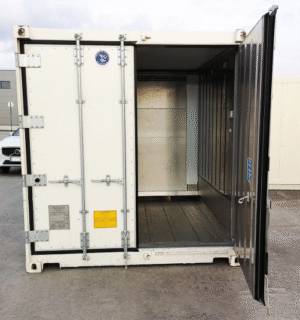
A buyer should consider an operational reefer whenever stored goods have strict temperature limits that ambient conditions would otherwise breach.
For properties with limited yard space, reviewing compact footprints such as 10 foot containers helps determine which physical profile fits available space. Before purchasing active reefers, always verify that the unit cooling machinery aligns with your documented temperature profile and that your local power supply matches equipment nameplate specifications.
Before completing a purchase for on-site storage, work through these essential equipment and site checks:
Whether your application calls for an insulated passive shell or a fully operational refrigerated container, confirm equipment specifications prior to delivery.
ContainerSupCon delivers containers to eligible United States addresses. Delivery address eligibility, specific unit condition, and fulfillment scheduling require a formal written quote. If your application demands active climate control, review our published 10 foot reefer container listing for equipment specifications, or call +1 (865) 336-0062 (Monday through Friday 08:00–17:00, Saturday 09:00–15:00 Eastern) to request an exact-unit quote for your location.